
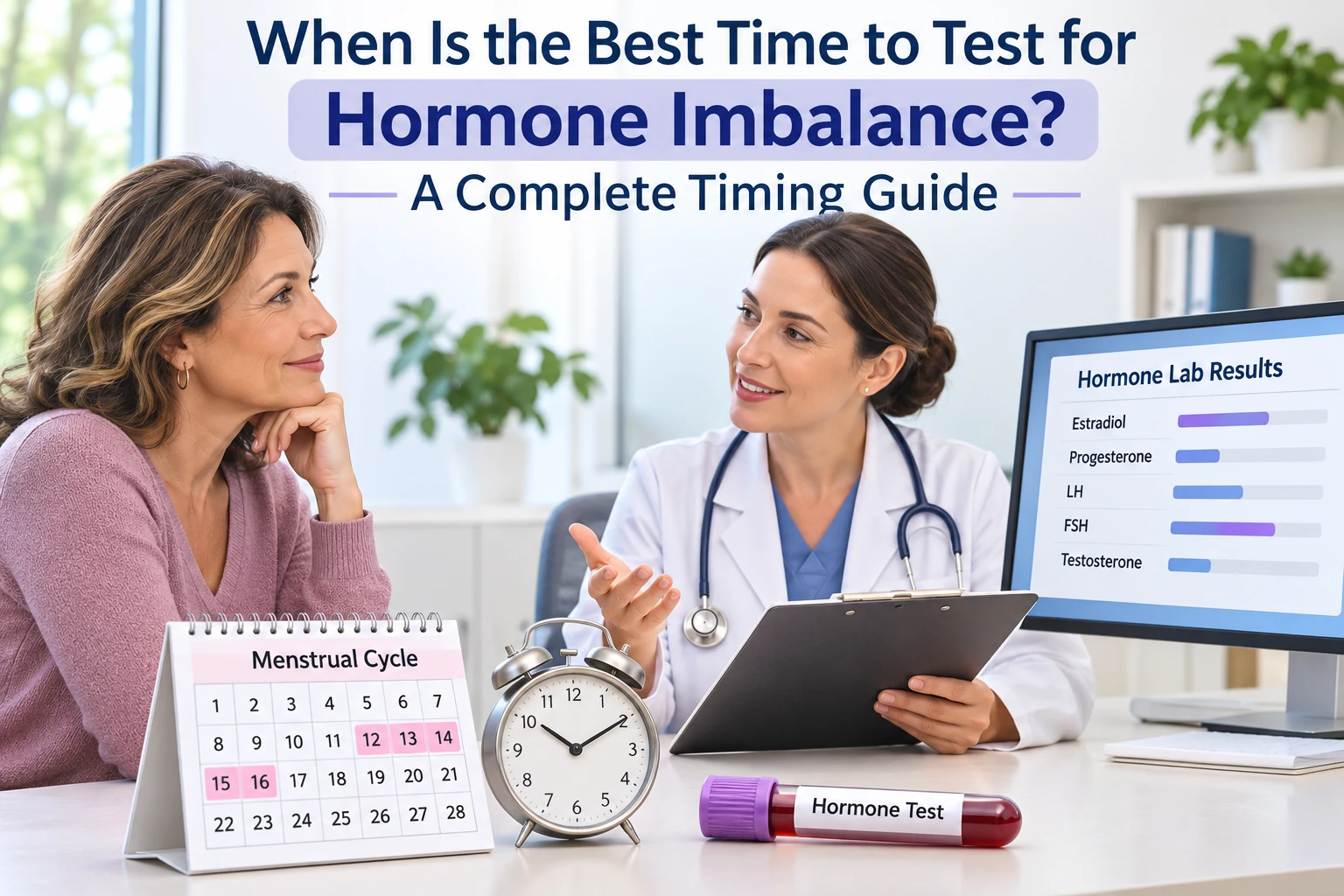
The best time to test for hormone imbalance depends on which hormone you’re checking and, for women, where you are in your cycle.
Testosterone and cortisol are most accurate between 7 and 10 a.m., estrogen and FSH are best checked on cycle day 3, and progesterone on day 21.
Perimenopause is the exception, since hormone levels swing too widely for one test to mean much.
You finally got your hormones checked.
Then the results came back “normal,” even though you still feel exhausted, moody, or foggy every day.
This happens more often than you’d think, and it’s rarely because nothing is wrong.
It’s usually because of when the blood was drawn.
Hormone levels shift by the hour, and for women, by the day of the cycle.
Testing at the wrong moment can hide a real imbalance or make a healthy result look abnormal.
Knowing the best time to test for hormone imbalance matters just as much as deciding to test in the first place.
SEE IF HORMONE THERAPY IS RIGHT FOR YOU
When Is the Best Time to Test for Hormone Imbalance?
The best time to test for hormone imbalance is in the morning, generally between 7 and 10 a.m., because hormones like testosterone and cortisol are highest right after waking and drop as the day goes on.
Women also need to match testing to their cycle: day 3 for estrogen, FSH, and LH, and day 21 for progesterone.
There isn’t one universal answer, because timing depends on the hormone, your sex, and sometimes your life stage.
The sections below break down exactly when to test each one, so you walk into your appointment with results you can actually trust.
Why Does Timing Change Your Hormone Test Results So Much?
Timing changes your results because most hormones follow a daily or monthly rhythm instead of sitting at one constant level.
Cortisol and testosterone can swing by 20 to 50 percent between morning and afternoon, and estrogen and progesterone move dramatically across the menstrual cycle.
A test drawn at the wrong moment can look completely normal even when a real imbalance exists.
This is a big part of why hormone-related conditions get missed for so long.
Women with endometriosis, which is driven by hormonal activity, often wait more than six years on average to get a correct diagnosis.
A lot of that delay comes from inconclusive labs that were drawn at a point in the cycle that didn’t show the full picture.
Getting the timing right the first time saves you from repeat visits, repeat blood draws, and months of being told you’re fine when you clearly aren’t.
What Is the Best Time of Day to Test Testosterone and Cortisol?
Testosterone and cortisol are both best tested in the morning, between 7 and 10 a.m., because that’s when levels peak before they decline throughout the day.
Testing either hormone later can produce a falsely low reading even when nothing is actually wrong.
Testosterone: Morning, Fasted, Confirmed Twice
Testosterone peaks shortly after you wake up and can fall by 20 to 50 percent by the afternoon.
Clinical guidelines from the Endocrine Society recommend measuring fasting morning testosterone and confirming a low result with a second early-morning test on a different day before making any diagnosis.
Men under 45 see the sharpest morning-to-afternoon drop, so testing before 10 a.m. matters most for them.
Men 45 and older have a bit more flexibility, since levels fluctuate less with age, but morning testing is still the safest bet.
If low testosterone and symptoms like low energy or low libido are affecting your daily life, andropause may be worth discussing with a provider who can test and treat it together, through options like testosterone replacement therapy.
Cortisol: Right After Waking
Cortisol follows its own daily rhythm.
According to the Cleveland Clinic, cortisol peaks within the first 30 to 45 minutes after you wake up and then declines steadily, reaching its lowest point around midnight.
Testing between 7 and 9 a.m. captures that peak most reliably.
A pattern of chronic fatigue, trouble waking up, or feeling “wired but tired” can point to adrenal fatigue, which is worth exploring with timed cortisol testing rather than a single random draw.
When Should Women Test Hormones During Their Cycle?
Women should time hormone testing to specific days of their menstrual cycle to get an accurate read.
Estrogen, FSH, and LH are checked on day 3, in the early follicular phase, while progesterone is measured on day 21, about a week after ovulation in a typical 28-day cycle.
Day 3: Estrogen, FSH, and LH
Day 3 of your cycle (counting from the first day of full flow) gives a baseline reading before the hormones that drive ovulation start climbing.
This is the standard window for checking estrogen, FSH, and LH, and it’s the same window your provider will likely use if they suspect hormone replacement therapy for women might help.
Day 21: Progesterone
Progesterone peaks about seven days after ovulation, which lands on day 21 for a classic 28-day cycle.
If your cycle runs longer or shorter, that window shifts too.
A 32-day cycle, for example, pushes the ideal testing day closer to day 25.
A provider who actually tracks your cycle length will catch this; a generic lab order often won’t.
Irregular or Absent Periods
Without a predictable cycle, calendar-based testing doesn’t work.
Women with irregular periods, including the 5 to 15 percent affected by polycystic ovary syndrome, usually need ovulation tracking or clinician-guided timing instead of a fixed day.
The same applies to women on hormonal birth control, since synthetic hormones can mask what your body is actually producing.
Why Perimenopause Makes Hormone Testing Trickier
Perimenopause breaks the usual timing rules.
Mayo Clinic notes that no single test can confirm perimenopause, because hormone levels change unpredictably during this transition rather than following the steady patterns seen earlier in a woman’s reproductive years.
Research backs this up.
A review of global perimenopause data found that FSH and estradiol are unreliable guides to menopausal status once a woman enters this stage, since both can swing widely from one week to the next in the same person.
That’s why a good provider leans on symptoms, age, and menstrual history alongside any labs, instead of chasing a single number.
This is where a functional approach to menopause tends to serve women better than a one-off hormone panel, because it looks at the whole pattern rather than a single snapshot.
If you’re noticing new mood shifts, sleep trouble, or irregular cycles, both perimenopause and menopause are worth ruling in or out with a provider who treats the whole picture.
Does Thyroid Testing Follow the Same Timing Rules?
Thyroid testing does not follow the same strict timing rules as sex hormones or cortisol.
TSH and thyroid hormone levels stay fairly stable throughout the day, so most people can test at any time, though morning testing before eating or taking thyroid medication gives the most consistent results.
Thyroid problems are also far more common than most people realize.
The American Thyroid Association estimates that one in eight women will develop a thyroid disorder at some point in her life, often with symptoms, like fatigue and weight changes, that overlap heavily with other hormone imbalances.
If fatigue, weight changes, or brain fog have been dragging on, thyroid dysfunction deserves a look alongside your other hormone levels.
Signs Your Hormones Might Be Out of Balance
Hormone imbalance can show up in ways that feel scattered and unrelated, which is part of why it gets missed.
Common signs include:
- Persistent fatigue that doesn’t improve with sleep
- Unexplained weight gain or difficulty losing weight
- Mood swings, anxiety, or new irritability
- Low libido or changes in sexual function
- Irregular, heavy, or missed periods
- Brain fog or trouble concentrating
- Hot flashes, night sweats, or disrupted sleep
These symptoms are extremely common.
Vasomotor symptoms like hot flashes affect more than 80 percent of women during the menopausal transition, and mood changes tied to hormone shifts are just as real, even if they’re harder to measure on a lab report.
If anxiety or mood changes have shown up alongside physical symptoms, that combination is worth mentioning to your provider, since it often points toward hormones rather than a separate issue.
Weight that won’t budge despite no change in diet or exercise, low libido that doesn’t match your usual baseline, and persistent mood swings are three of the clearest signals that it’s time to test rather than wait it out.
If any of these sound familiar, it’s worth exploring weight gain, low libido, or mood swings as hormone-related, not just stress or aging.
GET HELP BALANCING YOUR HORMONES
How to Prepare for an Accurate Hormone Test
The best way to prepare for a hormone test is to schedule it for the right time of day or cycle day, fast for 8 to 12 hours if your provider recommends it, skip intense exercise for 24 hours beforehand, and get a normal night of sleep.
Stress, recent meals, and poor sleep can all shift hormone readings by 20 to 40 percent.
Fasting status matters more for some hormones than others.
One study on fasting versus non-fasting testosterone levels in women found measurable differences depending on when the last meal was eaten, which is one more reason a generic walk-in lab order often falls short of what a planned, provider-guided test can do.
A short checklist before your appointment: confirm the correct cycle day if you’re a woman with periods, book a morning slot, avoid your workout that day, skip alcohol the night before, and bring a list of your current medications and supplements, since some, like biotin, can skew results.
How First Call DPC Helps Florida Patients Test and Treat Hormone Imbalance
Getting the timing right is only half the battle.
The other half is having a physician who can actually order the right test, at the right moment, and get you real answers instead of a one-line “normal” result.
That’s the gap First Call DPC was built to close.
As a direct primary care practice with a strong functional medicine foundation across Florida, our physicians look for the root cause behind fatigue, weight changes, mood shifts, and low libido instead of treating each symptom separately.
Because you have direct access to your doctor, timing a test to your cycle, your schedule, or a specific symptom pattern is something we plan together, not something left to chance.
We offer hormone therapy for both women and men, including hormone replacement therapy for men, so whether you’re dealing with perimenopause, andropause, thyroid symptoms, or adrenal fatigue, you’re working with a team that treats the full picture rather than a single number on a page.
If your last set of labs left you with more questions than answers, that’s usually a sign it’s time for a second look, done at the right time, with a provider who has the time to explain what the results actually mean.
FAQs: When Is the Best Time to Test for Hormone Imbalance
What happens if I test hormones at the wrong time?
Testing at the wrong time can produce a result that looks normal even when a real imbalance exists, or the reverse, a result that looks abnormal when it isn’t. This is especially common with testosterone, cortisol, and the cycle-dependent hormones in women, since all of them shift significantly within a single day or month.
Can I test hormone levels while on birth control?
Hormonal birth control suppresses your body’s natural cycle, so standard cycle-day testing for estrogen, FSH, and LH won’t reflect your natural levels. If you need an accurate baseline, your provider may recommend testing after stopping birth control for a period of time, or focusing on hormones that aren’t affected by it, like thyroid markers.
Do I need to fast before a hormone test?
It depends on the hormone. Testosterone is typically tested after an overnight fast, and recent food intake can shift results. Thyroid testing is more flexible, since levels stay fairly stable throughout the day regardless of meals.
How soon can I retest after starting treatment?
Most hormone treatments need 6 to 12 weeks before levels stabilize enough for a meaningful retest. Testing too soon after starting therapy often shows a result that’s still in flux rather than your true, treated level.
Is at-home hormone testing as accurate as testing at a clinic?
At-home kits can be useful for tracking trends, but they vary widely in accuracy and rarely account for the timing nuances described above. A provider-guided test, drawn at the correct time of day or cycle day, gives you a more reliable result and someone qualified to interpret it.
Can men’s testosterone be tested any time of day after age 45?
Men 45 and older see less dramatic swings in testosterone throughout the day, so testing before early afternoon is generally acceptable. Morning testing is still the most reliable choice at any age, since it captures levels closest to their natural peak.